20 Jun 2026 · updated 15 Sept 2026 · Ger
How to measure ERD with two different-length spokes
On this page
You can measure ERD with two spokes of different lengths. For this Dartmoor rim, I used one 184 mm spoke and one 290 mm spoke because I didn’t have a matching pair. With two nipples and a caliper, I measured an ERD of 542 mm on the rim itself.
These are my notes and a photo of the process, for next time and for anyone making the same check before ordering spokes. The arithmetic is simple. What matters is where you measure from and how far you thread each spoke into its nipple.
What you’re measuring when you measure ERD
ERD, or Effective Rim Diameter, is the diameter of the circle reached by the spoke tips inside the nipples. The calculator uses it alongside the hub dimensions and crossing pattern to work out spoke length.
The measurement reference is at the spoke tips inside the nipples. Outer diameter and tyre bead-seat diameter describe other parts of the rim. Use the nipples you intend to build with, including nipple washers if the build calls for them.
Choose your nipple reference point first
For the measurement in this article, I set each spoke tip flush with the top of the nipple head. That is the reference behind my 542 mm result.
Another common reference is the bottom of the screwdriver slot, below the top of the head. This is the reference used in Park Tool’s ERD measurement method.
With the same nipples, measuring to the top of the head gives a larger ERD than measuring to the bottom of the slot. The two-spoke method works for either reference; the difference between the results depends on the nipple’s dimensions.
Choose the reference according to the guidance for your components and record it with the result. Check the intended spoke-tip position for your nipple model before applying the reference I used here to another build.
How to measure with two spokes and a caliper
For this measurement I used:
- Two J-bend spokes of known length. They can be different lengths, but together they must leave a gap between the bends that your caliper can measure.
- Two nipples, one for each spoke.
- A caliper to measure the gap.
If you’re unsure of either spoke’s length, check it with a spoke ruler first. A J-bend spoke is measured from the inside of the elbow to the threaded tip, not from the outer edge of its head.
- Write down both lengths separately: L1 and L2. There’s no need to find a matching pair or cut one spoke to match the other.
- Fit the spokes in diametrically opposite rim holes. Thread the nipples on until both tips reach your chosen reference. In my case, that was flush with the top of the nipple head. Include washers if you’ll use them in the build.
- Pull the spoke heads inwards. This seats the nipples against the rim or washers. Keep them seated while you measure.
- Measure inside-to-inside of the bends. Place the narrow tips of the caliper jaws against the inside faces of both elbows. Keep the spokes aligned along the same diameter. If one tilts or a nipple lifts, reposition it before taking the reading. Don’t measure between the outer edges of the spoke heads.
- Add both spoke lengths and the gap:
ERD = L1 + L2 + gap. - Repeat across another diametrically opposite pair of holes. Check that the measurement is repeatable and keep a note of the nipple reference before ordering spokes.
With different-length spokes, the gap sits away from the centre of the rim. That’s normal. What matters is measuring along the same diameter and using the correct reference on both elbows.
My Dartmoor measurement: 542 mm
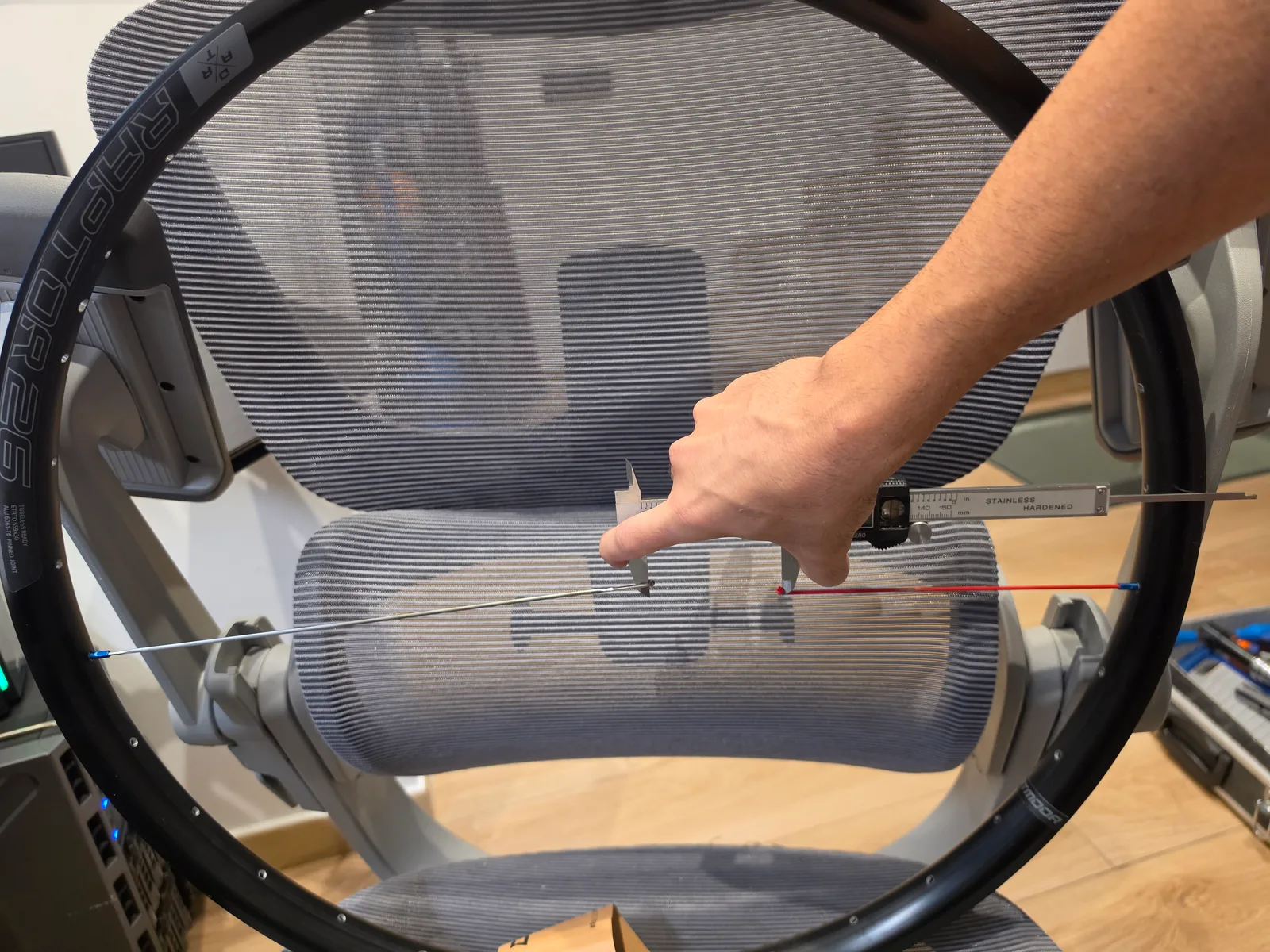
These were my measurements, with the spoke tips flush with the tops of the nipple heads:
| Measurement | Value |
|---|---|
| Spoke A (L1) | 184 mm |
| Spoke B (L2) | 290 mm |
| Inside-to-inside gap between the bends | 68 mm |
| ERD calculated from the measurements | 542 mm |
ERD = L1 + L2 + gap
ERD = 184 + 290 + 68
ERD = 542 mm
The result matched the ERD I had looked up for this rim in Dartmoor’s documentation. I still measured it myself to check it with my nipples, rather than relying solely on the manufacturer’s figure. The 542 mm result belongs to this rim and this reference point. Measure your own rim and nipple combination before using that figure.
Had both spokes been the same length, I could have used the shorter formula
ERD = 2 × L + gap. With 184 and 290 mm spokes, you need to add each length separately.
For an asymmetric rim, check the offset too
ERD and offset are separate measurements. ERD describes the diameter; offset is the sideways displacement of the spoke-hole line from the centre of the rim.
On this Dartmoor, I also checked an offset of approximately 1.5 mm. Measuring from the spoke-hole line to equivalent points on each rim edge, the side with the shorter distance is the side the holes are offset towards.
Note which side of the wheel that offset will face when you build it. Left and right are viewed from the rider’s position, sitting on the bike. Rim orientation matters when calculating each side and lacing the wheel. Enter the 1.5 mm in the offset field and keep the measured ERD in its own field.
Mistakes to avoid before ordering spokes
A 1 mm error in ERD changes the calculated length of each spoke by approximately 0.5 mm for typical wheel geometry. That can be enough to move you to a different available spoke length.
- Mixing up nipple references. The top of the head, bottom of the slot and nipple seat are different points. Their measurements aren’t interchangeable.
- Measuring spokes from the outside of the head. For the sum to work, each reference length must end where the gap measurement begins: at the inside of the elbow.
- Letting a nipple lift off its seat. Keep pulling on both spokes while taking the reading and repeat the measurement if they move.
- Ordering from the rounded result alone. Check each side’s unrounded length and the spoke and nipple manufacturer’s guidance. A spoke that’s too short loses thread engagement; one that’s too long can bottom out or protrude.
Frequently asked questions
Do I need two spokes of the same length?
No. You need to know each spoke’s length and leave a gap you can measure. The general formula is L1 + L2 + gap. A matching pair just makes the arithmetic shorter.
Can I use the manufacturer’s ERD directly?
The rim database and the manufacturer’s documentation are useful starting points. Check which nipples, washers and reference point were used. If those details aren’t clear, measure your own rim with the intended components before ordering spokes.
My measurement is 3 mm off the listed ERD. Which is right?
Check the spoke lengths, the reference at their tips and how the nipples are seated, then repeat across another diameter and compare how the published value was obtained. You can repeat a measurement using the same wrong reference each time, so resolve the difference before choosing the ERD for your calculation.
What if I measure the diameter between the nipple seats?
You still need the distance from each seat to the intended spoke tip. If A is the seat diameter and B1 and B2 are those outward distances:
ERD = A + B1 + B2You can only use A + 2 × B if both distances are equal. B is not the nipple’s overall
length, and there is no universal correction for every nipple.
Once you’ve checked the measurement, enter your ERD in the length calculator and keep a note of the nipples, washers and reference point with your build. To carry on, see the wheelbuilding guide and the glossary for the other dimensions.